

The DeFi domino effect has emerged as one of the most pressing concerns in the cryptocurrency ecosystem, sending shockwaves through investors, developers, and regulators alike. As decentralized finance protocols become increasingly interconnected, the failure of a single platform can trigger a catastrophic chain reaction that threatens the entire digital asset landscape. With billions of dollars locked in smart contracts and protocols that depend on each other for liquidity and stability, the potential for hidden crises lurking beneath the surface has never been more pronounced. Understanding these systemic risks is crucial for anyone participating in the decentralized finance revolution, as the consequences of ignorance could prove financially devastating.
The rapid growth of decentralized finance has created an intricate web of dependencies that few fully comprehend. Unlike traditional financial systems with established safety nets and regulatory oversight, DeFi operates in a largely unregulated environment where smart contract vulnerabilities, liquidity crunches, and contagion risks can spread at lightning speed. This article explores the mechanisms behind the DeFi domino effect, examines historical precedents, and provides actionable insights to help you navigate this volatile landscape while protecting your digital assets.
DeFi Domino Effect Phenomenon
The DeFi domino effect refers to the cascading failure mechanism that occurs when interconnected decentralized finance protocols experience sequential collapses. This phenomenon mirrors traditional financial contagion but operates with unique characteristics inherent to blockchain technology and cryptocurrency markets.
At its core, the domino effect in decentralized finance stems from three fundamental factors: protocol interdependence, shared liquidity pools, and cross-collateralization. When one major protocol fails or experiences a security breach, the ripple effects propagate through connected platforms faster than traditional financial systems due to the automated nature of smart contracts and the absence of circuit breakers that exist in conventional markets.
The Mechanics of Cascading Protocol Failures
Decentralized finance platforms rarely operate in isolation. Most protocols integrate with multiple other platforms to provide enhanced functionality, better yields, or expanded services. This interconnectedness creates a complex ecosystem where:
- Lending protocols depend on accurate price oracles from external sources
- Yield aggregators distribute funds across multiple platforms simultaneously
- Decentralized exchanges rely on liquidity providers who often have positions across numerous protocols
- Synthetic asset platforms require collateral that may be locked in other DeFi applications
When a critical component fails, these dependencies create a domino-like cascade. For instance, if a major lending protocol experiences a smart contract exploit, borrowers may rush to withdraw collateral from connected platforms, causing liquidity shortages that spread throughout the ecosystem. This panic-driven behavior amplifies the initial shock, creating secondary and tertiary effects that can dwarf the original incident.
Historical Examples of DeFi Contagion Events

The cryptocurrency industry has witnessed several instances where the DeFi domino effect manifested with devastating consequences. The Terra-Luna collapse in May 2022 serves as a prime example, where the algorithmic stablecoin UST’s depeg triggered a death spiral that wiped out over $60 billion in market value and caused cascading failures across multiple platforms that had integrated Terra ecosystem tokens.
Similarly, the Three Arrows Capital liquidation cascade demonstrated how interconnected leverage and counterparty risk could propagate through both centralized and decentralized finance platforms. When 3AC defaulted on loans from multiple lenders, it triggered a chain reaction affecting Genesis, BlockFi, Voyager Digital, and numerous DeFi protocols that had exposure to these entities.
Hidden Crises Lurking Beneath the Surface
Beyond the obvious risks that market participants can observe, several hidden crises in DeFi remain largely undetected until they materialize into full-blown emergencies. These concealed vulnerabilities represent ticking time bombs that could trigger the next major domino effect.
Smart Contract Vulnerabilities and Audit Limitations
Despite rigorous security audits, smart contracts contain inherent risks that only become apparent under specific conditions or attack vectors. The DeFi domino effect can be triggered by:
Undiscovered exploit pathways remain dormant until malicious actors identify and weaponize them. Even audited contracts have proven vulnerable, as seen in numerous high-profile hacks affecting protocols like Poly Network, Ronin Bridge, and Cream Finance.
Composability risks emerge when multiple protocols interact in unexpected ways. A secure smart contract in isolation may exhibit dangerous behaviors when combined with other protocols, creating vulnerability surfaces that no single audit could anticipate.
Upgradeability concerns present another hidden crisis. Many protocols employ proxy contracts or governance mechanisms that allow code updates. While this flexibility enables bug fixes, it also introduces centralization risks and the possibility of malicious upgrades that could compromise user funds.
Liquidity Illusions and Market Depth Deceptions
The apparent liquidity in many DeFi protocols masks the underlying fragility that becomes evident only during stress events. Several factors contribute to this liquidity illusion:
Circular dependencies exist where liquidity providers use their LP tokens as collateral to borrow more assets, which they then deploy as liquidity elsewhere. This recursive leverage creates the appearance of deep markets while actually concentrating risk.
Mercenary capital flows between protocols chasing the highest yields, creating temporary liquidity that evaporates during crises. When yields compress or risks materialize, this capital withdraws simultaneously, triggering the DeFi domino effect as multiple protocols lose liquidity support concurrently.
Oracle manipulation risks allow attackers to temporarily distort price feeds, triggering cascading liquidations across multiple platforms. Flash loan attacks have demonstrated how attackers can manipulate thinly traded markets to create artificial price movements that propagate through interconnected protocols.
Systemic Risk Factors Amplifying the Domino Effect
Several structural characteristics of decentralized finance amplify contagion risks beyond what traditional finance experiences. Understanding these systemic risk factors is essential for assessing the true scope of potential DeFi crises.
Over-Collateralization Paradox
While over-collateralization provides safety buffers for individual loans, it creates systemic fragility when applied across the entire ecosystem. Borrowers must lock up more value than they receive, creating capital inefficiency that gets compounded through multiple protocol layers.
This paradox manifests during market downturns when cascading liquidations occur. As asset prices decline, collateral values drop below required thresholds, triggering automated liquidations that further depress prices. This feedback loop accelerates the DeFi domino effect, as liquidation sales in one protocol impact collateral values across all platforms simultaneously.
The problem intensifies with recursive borrowing, where users take their borrowed assets and use them as collateral elsewhere. A 10% market decline can trigger liquidation cascades that amplify the price movement to 30% or more as leveraged positions unwind across the ecosystem.
Governance Token Value Traps
Many DeFi protocols rely on governance tokens that serve multiple functions: voting rights, fee collection, and sometimes collateral within the platform itself. This creates dangerous circular dependencies where the protocol’s security depends on the token’s value, which in turn depends on the protocol’s perceived security.
When confidence erodes, governance token prices collapse, reducing protocol security budgets, incentivizing developer departures, and triggering insurance claims—all of which further undermine confidence. This vicious cycle has destroyed numerous protocols and contributed to broader DeFi domino effects as users flee to perceived safety.
Cross-Chain Bridge Vulnerabilities
As DeFi expands across multiple blockchains, cross-chain bridges have become critical infrastructure connecting separate ecosystems. These bridges represent concentrated points of failure where exploits can have devastating ripple effects across multiple chains simultaneously.
Bridge hacks have resulted in some of the largest losses in crypto history, with the Ronin Bridge exploit alone costing over $600 million. When a major bridge fails, assets become stranded on different chains, liquidity fragments, and protocols on both sides experience simultaneous stress—a perfect storm for triggering the DeFi domino effect.
Warning Signs of Impending DeFi Crises
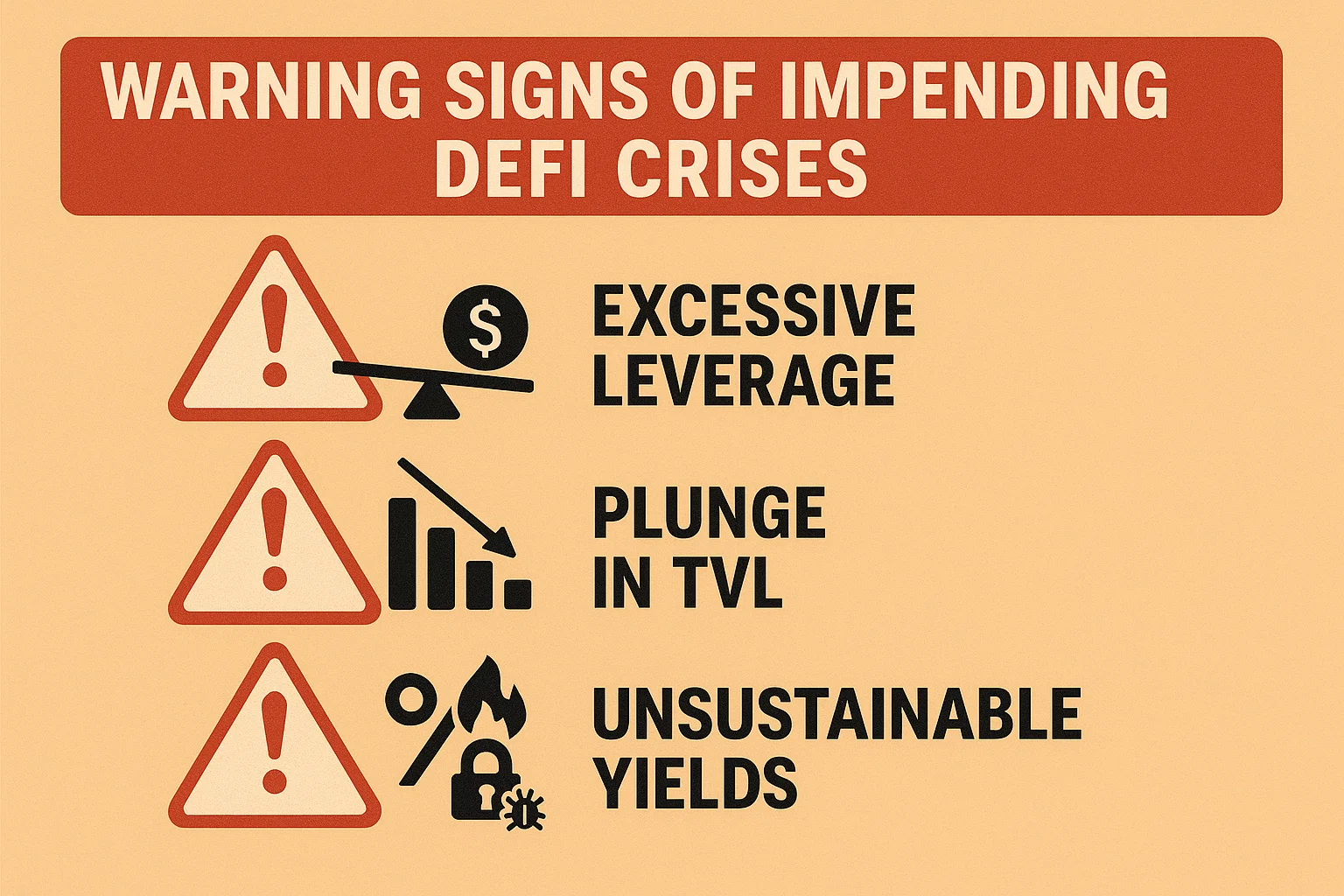
Astute observers can identify warning signs that precede major contagion events. Recognizing these indicators provides opportunities to reduce exposure before the DeFi domino effect materializes.
Abnormal Yield Curves and Incentive Distortions
When protocols offer yields significantly above sustainable levels, they typically rely on token emissions or unsustainable business models. These inflated returns attract mercenary capital that creates temporary stability while building long-term fragility.
Yield farming frenzies often precede major crashes, as protocols compete for total value locked by offering increasingly generous rewards. When token prices decline or emissions reduce, the capital exodus triggers liquidity crises across multiple platforms simultaneously.
Decreasing Collateralization Ratios
Monitoring aggregate collateralization ratios across major lending protocols provides early warning of systemic stress. As ratios approach minimum thresholds, the risk of cascading liquidations increases exponentially.
Sophisticated users track metrics like:
- Average health factors across major protocols
- Distribution of collateral types and concentration risks
- Growth rates of leverage versus underlying asset performance
- Correlation between governance token prices and protocol utilization
Unusual Oracle Behavior and Price Discrepancies
Price oracle failures have triggered numerous DeFi crises. Monitoring for unusual discrepancies between Oracle prices and market reality can provide early warning of impending problems.
Specific warning signs include:
- Increasing variance between different oracle sources
- Delayed price updates during volatile market conditions
- Growing spreads between decentralized exchange prices and centralized exchange prices
- Flash crash patterns that suggest oracle manipulation attempts
Protecting Yourself from the DeFi Domino Effect
While eliminating risk remains impossible in decentralized finance, several strategies can significantly reduce your exposure to cascading protocol failures and hidden crises.
Diversification Beyond Protocol Level
Traditional diversification advice focuses on spreading investments across different protocols. However, effective protection from the DeFi domino effect requires deeper diversification:
Blockchain diversification reduces exposure to chain-specific failures. Spreading assets across Ethereum, Binance Smart Chain, Avalanche, Polygon, and other Layer 1 or Layer 2 solutions prevents total loss if one ecosystem experiences critical failures.
Collateral type diversification protects against asset-specific crashes. Avoiding over-concentration in any single token, even blue-chip cryptocurrencies like Bitcoin or Ethereum, provides resilience when specific assets experience unexpected volatility.
Protocol architecture diversification means using platforms with different technical approaches. Combining automated market makers, order book exchanges, and peer-to-peer lending spreads technical risk across different smart contract patterns.
Due Diligence Framework for DeFi Protocols
Before committing significant capital to any protocol, implement a comprehensive due diligence framework:
Audit history verification involves checking which security firms have reviewed the code, when audits occurred, and whether identified issues were addressed. Multiple audits from reputable firms provide greater confidence but never guarantee absolute security.
Team transparency assessment examines whether developers are doxxed, their track records in previous projects, and their responsiveness to community concerns. Anonymous teams carry elevated risks during crises.
Financial sustainability analysis determines whether the protocol generates sufficient revenue to maintain operations without relying solely on token inflation. Protocols with actual revenue streams demonstrate greater long-term viability.
Governance centralization evaluation identifies how much control core teams retain versus community governance. Excessive centralization creates risks of malicious actions or regulatory pressure, while excessive decentralization can prevent timely crisis responses.
Emergency Preparedness and Exit Strategies
Having predetermined exit strategies prevents emotional decision-making during crisis periods when the DeFi domino effect materializes:
Trigger-based withdrawal plans establish specific thresholds that automatically prompt asset withdrawal. For example, removing funds when total value locked drops by 20%, when governance token prices decline by 50%, or when unusual oracle behavior appears.
Liquidity reserves maintained outside DeFi protocols provide optionality during crises. Keeping 20-30% of crypto holdings in simple wallet custody or stablecoins on reputable centralized exchanges ensures you can capitalize on opportunities or cover emergencies without depending on DeFi protocol access.
Gas fee reserves on relevant blockchains ensure you can execute emergency transactions even when network congestion drives fees to extreme levels. Missing exit opportunities because you lack ETH for gas fees during the DeFi domino effect can prove extremely costly.
Regulatory Implications and Future Outlook
The increasing frequency and severity of DeFi crises have attracted regulatory attention worldwide, with significant implications for the industry’s future trajectory.
Evolving Regulatory Frameworks
Regulators increasingly view the DeFi domino effect as a systemic risk requiring oversight similar to traditional financial institutions. Several jurisdictions have begun implementing or proposing regulations specifically targeting decentralized finance:
Registration requirements for DeFi protocols operating in certain jurisdictions could mandate licensing, capital requirements, and consumer protection measures. While controversial within the crypto community, such regulations might reduce contagion risks by imposing safety standards.
Stablecoin regulations specifically address the algorithmic stablecoin risks demonstrated by Terra’s collapse. Many jurisdictions now require stablecoins to maintain full reserves and undergo regular attestations, reducing one vector for cascading failures.
Cross-border coordination among regulators recognizes that DeFi crises respect no geographic boundaries. International cooperation frameworks aim to prevent regulatory arbitrage while establishing baseline safety standards globally.
Technological Solutions in Development
The industry hasn’t remained passive in addressing DeFi domino effect risks. Several promising technological developments aim to enhance protocol resilience:
Circuit breakers and pause mechanisms allow protocols to halt operations during anomalous conditions, preventing exploitation while teams assess situations. Though controversial for compromising decentralization, these safety features increasingly appear in new protocols.
Insurance protocols like Nexus Mutual and InsurAce provide coverage against smart contract failures, reducing individual user exposure to protocol-specific risks. As these insurance markets mature, they could provide systemic stability by mutualizing risks across the ecosystem.
Advanced oracle solutions employing multiple independent data sources, cryptographic verification, and decentralized validator networks reduce manipulation risks that have triggered previous cascades. Protocols like Chainlink’s decentralized oracle networks represent significant improvements over earlier oracle designs.
Formal verification techniques enable mathematical proof of smart contract correctness under specified conditions. While expensive and time-consuming, formal verification provides higher security assurances than traditional auditing for critical financial infrastructure.
The Psychology of DeFi Contagion
Understanding the psychological factors driving the DeFi domino effect illuminates why cascading failures accelerate so dramatically and how investors might better manage emotional responses during crises.
Fear, Uncertainty, and Doubt Amplification
The pseudonymous nature of DeFi participants, combined with rapid information spread on social media, creates perfect conditions for panic amplification. When uncertainty emerges regarding a protocol’s solvency or security:
Information asymmetry causes users to assume worst-case scenarios, triggering preemptive withdrawals that become self-fulfilling prophecies. Unlike traditional finance, where official spokespersons can credibly reassure markets, DeFi’s decentralization often means no authoritative voice exists to counter misinformation.
Social media cascades spread fear faster than factual information can counter it. By the time protocol teams clarify situations, bank runs have already depleted liquidity, triggering the exact crisis that users feared.
Confirmation bias leads participants to interpret ambiguous information as confirming their fears during stress periods, while dismissing positive signals as manipulation or denial. This cognitive bias accelerates withdrawals during the DeFi domino effect.
Lessons from Traditional Financial Crises
Historical financial crises offer valuable insights for understanding DeFi contagion dynamics:
The 2008 financial crisis demonstrated how interconnected leverage, opacity regarding true risk exposure, and inadequate crisis management mechanisms could trigger global economic devastation. DeFi exhibits similar characteristics: complex leverage structures, opacity about true protocol dependencies, and limited crisis intervention capabilities.
However, DeFi also differs in critical ways. Blockchain transparency allows sophisticated observers to monitor risk accumulation in real-time, potentially providing earlier warning than traditional finance. Conversely, DeFi’s automation and absence of circuit breakers mean crises unfold faster than human decision-makers can respond.
Conclusion
The DeFi domino effect represents one of the cryptocurrency ecosystem’s most significant challenges, with hidden crises capable of triggering systemic failures that dwarf previous incidents. As decentralized finance continues evolving, understanding interconnected risks, recognizing warning signs, and implementing robust protection strategies becomes essential for any serious participant.
While the promise of decentralized finance—financial inclusion, permissionless innovation, and censorship resistance—remains compelling, these benefits carry corresponding risks that demand respect and careful management. The protocols and platforms that survive the coming challenges will likely be those that prioritize security, sustainability, and transparency over short-term growth metrics and unsustainable yields.
Read More: DeFi’s Decentralization, Centralization, and Maintenance