

The Bitcoin crypto slump continues to dominate headlines as digital asset markets face unprecedented challenges in 2025. Despite various interventions and proposed solutions, including recent government shutdown votes and regulatory discussions, the cryptocurrency market remains under significant pressure. Bitcoin, once hailed as digital gold and a hedge against traditional financial instability, has seen its value decline substantially over recent months. This persistent downturn has left investors questioning whether any single policy change or governmental decision can reverse the tide. The reality is far more complex than many realise, and understanding why the crypto slump continues requires examining multiple interconnected factors affecting the blockchain ecosystem today.
Current Bitcoin Crypto Slump
The Magnitude of Market Decline
The Bitcoin crypto slump continues to impact investors worldwide, with the leading cryptocurrency experiencing substantial losses throughout 2024 and into 2025. Bitcoin’s price has fluctuated dramatically from its previous all-time highs, with many altcoins suffering even steeper declines. This prolonged bearish trend represents more than just temporary volatility—it signals fundamental shifts in how digital assets are perceived and valued in the global financial ecosystem.
Market analysts point to several technical indicators suggesting that the crypto slump continues beyond normal correction territories. Trading volumes have decreased significantly, indicating reduced investor confidence and participation. The fear and greed index consistently shows extreme fear levels, while on-chain metrics reveal decreasing active addresses and transaction volumes. These factors combined paint a picture of a market in genuine distress rather than experiencing a typical cyclical downturn.
Historical Context of Cryptocurrency Downturns
To fully grasp why the Bitcoin crypto slump continues, we must examine previous bear markets. The 2018 crash saw Bitcoin lose over 80% of its value, while the 2022 downturn was triggered by high-profile collapses like FTX and Terra/Luna. However, the current situation differs in several key aspects. Unlike previous crashes driven primarily by speculation bubbles or isolated catastrophic failures, today’s market faces a perfect storm of macroeconomic pressures, regulatory uncertainties, and technological challenges simultaneously.
The cryptocurrency industry has matured considerably since earlier downturns, with institutional adoption, regulatory frameworks, and technological infrastructure far more developed. Yet paradoxically, this maturation hasn’t provided the stability many anticipated. Instead, as digital assets become more integrated with traditional finance, they’ve become increasingly susceptible to the same macroeconomic forces affecting stocks, bonds, and commodities.
Why Government Shutdown Votes Cannot Fix the Bitcoin Crypto Slump
The Disconnect Between Policy and Market Reality
One common misconception is that government decisions, particularly those related to shutdowns or budget votes, directly influence cryptocurrency markets in meaningful ways. While the crypto slump continues, some investors mistakenly believe that political resolutions will catalyse recovery. The truth is more nuanced and disappointing for those seeking quick fixes.
Government shutdown votes primarily affect traditional government operations, federal employee payments, and public services. While these events can indirectly impact consumer confidence and spending, their connection to cryptocurrency valuations is tenuous at best. The Bitcoin crypto slump continues due to factors far removed from domestic political negotiations, including global monetary policy, technological adoption rates, and fundamental questions about cryptocurrency utility and scalability.
Regulatory Uncertainty Versus Political Theatre
The distinction between substantive regulatory policy and political posturing is crucial when analysing why shutdown votes won’t resolve the crypto slump problem. Meaningful cryptocurrency regulation requires comprehensive legislation addressing taxation, securities classification, consumer protection, and anti-money laundering provisions. Shutdown negotiations typically revolve around spending levels and policy riders unrelated to digital asset frameworks.
Even when cryptocurrency provisions appear in budget discussions, they’re often superficial or tangential. Real regulatory clarity demands dedicated legislative efforts, regulatory agency guidance, and international coordination—none of which emerge from shutdown brinkmanship. Until comprehensive frameworks address the fundamental legal status of various digital assets, market uncertainty will persist regardless of government funding resolutions.
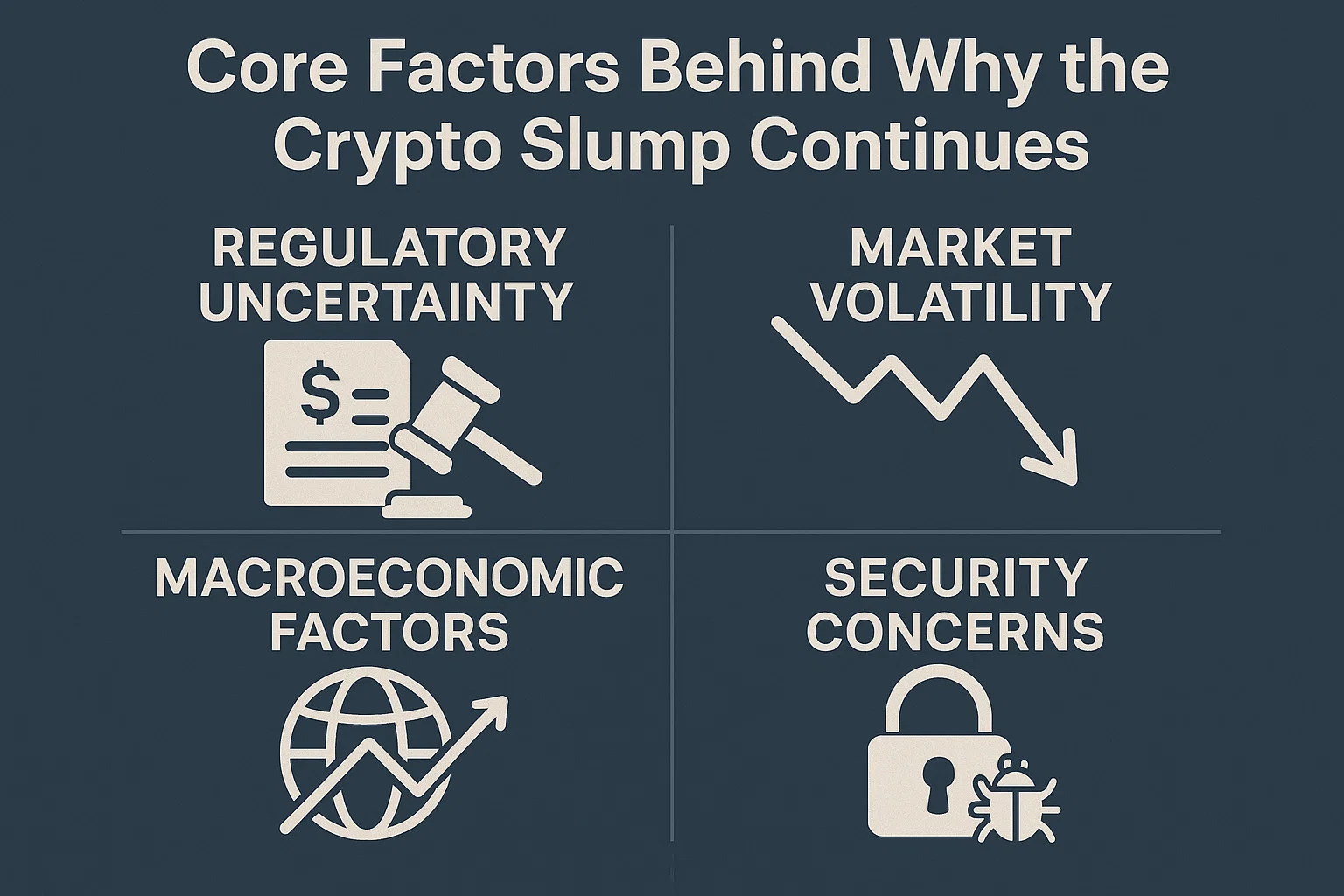
Core Factors Behind Why the Crypto Slump Continues
Macroeconomic Headwinds and Monetary Policy
The Bitcoin crypto slump continues largely because of persistent macroeconomic challenges that transcend any single political event. Central banks worldwide, particularly the Federal Reserve, have maintained relatively tight monetary policies to combat inflation. Higher interest rates make risk assets like cryptocurrencies less attractive compared to safer investments offering guaranteed returns. When treasury bills yield 4-5%, the speculative appeal of volatile digital assets diminishes considerably.
Additionally, global economic uncertainty stemming from geopolitical tensions, trade disputes, and recession concerns drives investors toward traditional safe havens rather than experimental assets. The crypto slump continues as institutional investors prioritise capital preservation over growth opportunities. This risk-averse environment systematically favours established financial instruments with predictable returns and regulatory protections.
Institutional Investor Retreat
Following the approval of Bitcoin ETFs in 2024, many anticipated that institutional capital would flood cryptocurrency markets and stabilise prices. While ETFs initially generated enthusiasm, sustained institutional investment hasn’t materialised as expected. The Bitcoin crypto slump continues partly because sophisticated investors remain cautious about deploying significant capital into volatile, still-maturing asset classes.
Institutional investors face fiduciary responsibilities requiring rigorous risk assessment and portfolio diversification. Many have concluded that cryptocurrency exposure should remain minimal or absent entirely from balanced portfolios. Pension funds, endowments, and insurance companies—the deep-pocketed investors capable of moving markets—have largely stayed on the sidelines despite regulatory approvals enabling participation.
Technological Challenges and Scalability Issues
Beyond financial factors, the crypto slump continues because fundamental technological limitations remain unresolved. Bitcoin’s network can process roughly 7 transactions per second, compared to Visa’s thousands per second. While layer-2 solutions like Lightning Network aim to address scalability, adoption remains limited and implementation complex for average users.
Energy consumption concerns also persist, with Bitcoin mining consuming as much electricity as entire countries. Environmental, social, and governance (ESG) considerations increasingly influence investment decisions, and cryptocurrency mining’s carbon footprint poses reputational and practical risks. Until the industry demonstrates sustainable scalability without compromising decentralisation or security, mainstream adoption will remain constrained.
Market Sentiment and Psychological Factors
The Fear, Uncertainty, and Doubt (FUD) Cycle
The Bitcoin crypto slump continues perpetuating itself through negative sentiment cycles. When prices decline, media coverage becomes increasingly pessimistic, which further erodes confidence and triggers additional selling. This self-reinforcing cycle operates independently of fundamental value or technological developments, creating momentum that political events cannot interrupt.
Social media amplifies both positive and negative sentiment, creating echo chambers where bearish perspectives dominate during downturns. Retail investors, who comprise a significant portion of cryptocurrency market participants, are particularly susceptible to emotional decision-making. Fear of missing out (FOMO) drives buying during rallies, while fear of losing everything (FOLE) triggers panic selling during declines.
The Absence of Compelling Use Cases
A fundamental reason the crypto slump continues is the persistent lack of mainstream use cases that justify cryptocurrency valuations. Despite over a decade of development, cryptocurrencies remain primarily speculative investments rather than functional currencies or indispensable technologies. Most retail transactions still occur in fiat currencies, and blockchain applications outside of speculation haven’t achieved product-market fit.
Decentralised finance (DeFi) promised to revolutionise banking and financial services, yet it remains niche with user experiences far inferior to traditional alternatives. Non-fungible tokens (NFTs) captured attention during 2021’s bull market but have since proven to be largely speculative bubbles without sustainable demand. Until cryptocurrencies demonstrate clear advantages over existing solutions for specific problems, the Bitcoin crypto slump continues reflecting realistic value assessments.
Regulatory Landscape and Its Impact
Global Regulatory Fragmentation
The crypto slump continues partly because the regulatory environment remains fragmented and unpredictable across jurisdictions. What’s permitted in one country may be prohibited in another, creating compliance nightmares for businesses and uncertainty for investors. Major economies like China have banned cryptocurrency trading entirely, while others like El Salvador have embraced Bitcoin as legal tender. This lack of international consensus inhibits institutional adoption and legitimate business development.
The United States itself presents regulatory confusion, with multiple agencies claiming jurisdiction over various aspects of digital assets. The Securities and Exchange Commission (SEC) treats many cryptocurrencies as securities, while the Commodity Futures Trading Commission (CFTC) classifies Bitcoin and Ethereum as commodities. State-level regulations add another layer of complexity, with New York’s BitLicense requirements differing substantially from Wyoming’s crypto-friendly frameworks.
The Enforcement Environment
Recent years have seen aggressive enforcement actions against cryptocurrency companies, exchanges, and projects. The Bitcoin crypto slump continues as regulatory crackdowns create existential risks for industry participants. High-profile cases against major exchanges for alleged securities violations, money laundering, or consumer fraud have demonstrated that regulatory tolerance for grey areas has evaporated.
This enforcement environment affects even legitimate projects trying to operate compliantly. The costs of legal compliance, the risks of retroactive enforcement, and the possibility of business model disruption through regulatory interpretation changes all contribute to decreased investment and innovation in the space. Venture capital funding for cryptocurrency projects has declined substantially, reflecting investor recognition that regulatory risks may outweigh potential returns.
Technical Analysis and Market Structure
Liquidity Concerns and Market Depth
The crypto slump continues, exacerbated by persistent liquidity issues across digital asset markets. Despite cryptocurrency’s reputation for 24/7 trading, actual market depth—the ability to execute large orders without significant price impact—remains limited compared to traditional financial markets. This thin liquidity means that relatively modest selling pressure can trigger disproportionate price declines.
Market makers and liquidity providers have reduced their activity following several high-profile losses during previous volatility episodes. The collapse of algorithmic stablecoin Terra and the subsequent contagion affecting lending platforms like Celsius and Voyager demonstrated how quickly liquidity can evaporate during crisis periods. Without deep, resilient liquidity pools, markets remain vulnerable to cascading liquidations and flash crashes that amplify the Bitcoin crypto slump continues narrative.
Derivative Markets and Leverage
Cryptocurrency derivative markets, including futures and perpetual contracts, often dwarf spot trading volumes. While derivatives provide price discovery and hedging mechanisms, they also enable extreme leverage that amplifies volatility. The crypto slump continues partly because overleveraged positions get liquidated during price declines, triggering further selling and creating downward spirals.
Many retail traders utilise 50x, 100x, or even higher leverage on cryptocurrency positions—levels that would be unthinkable in regulated traditional markets. When markets move against these positions, exchanges automatically liquidate them to prevent losses exceeding deposited collateral. These forced liquidations cascade through price levels, creating the dramatic crashes and rallies that characterise cryptocurrency markets and perpetuate instability.
Comparing Bitcoin to Traditional Assets
The Digital Gold Narrative Unravelling
Bitcoin was marketed as “digital gold”—a scarce store of value providing inflation protection and portfolio diversification. However, the Bitcoin crypto slump continues simultaneously with traditional market declines, undermining claims of uncorrelated returns. When equity markets fell throughout 2022 and experienced volatility in 2024-2025, Bitcoin declined alongside them rather than serving as a hedge.
This correlation with risk assets, rather than behaving like gold or other safe havens, reveals that markets treat Bitcoin as a speculative technology investment rather than a store of value. Gold has existed as a wealth preservation tool for millennia, with demonstrated performance during crises. Bitcoin, by contrast, has only existed through one major economic cycle and has failed the store-of-value test during periods when investors most needed protection.
Competition from Stablecoins and CBDCs
Ironically, the crypto slump continues while interest grows in stablecoins and central bank digital currencies (CBDCs)—cryptocurrency technologies that compete with Bitcoin rather than complement it. Stablecoins like USDC and USDT maintain a peg to fiat currencies, providing blockchain transaction efficiency without price volatility. For users seeking cryptocurrency benefits without speculation, stablecoins offer superior functionality.
Meanwhile, central banks worldwide are developing or piloting CBDCs that would provide government-backed digital currencies with blockchain-like features. If CBDCs achieve widespread adoption, they could satisfy demand for digital payments and programmable money while eliminating many purported advantages of decentralised cryptocurrencies. The Bitcoin crypto slump continues as these alternatives potentially capture use cases that originally justified cryptocurrency development.
What Would Actually Help Resolve the Crypto Slump

Genuine Regulatory Clarity
While shutdown votes won’t help, comprehensive regulatory frameworks addressing cryptocurrency’s legal status, taxation, and operational requirements could significantly impact why the crypto slump continues. Investors and businesses need certainty about how digital assets will be treated, what compliance requirements apply, and how rights and protections function in this space.
Effective regulation should balance innovation enablement with consumer protection, providing guardrails without stifling development. Clear rules about which tokens constitute securities, how staking rewards are taxed, what disclosure requirements apply to projects, and how custody responsibilities function would remove significant uncertainty currently suppressing institutional participation and legitimate business development.
Demonstrated Real-World Utility
The Bitcoin crypto slump continues fundamentally because cryptocurrencies haven’t proven indispensable for solving real-world problems. Reversing this trend requires demonstrating compelling use cases where blockchain technology provides clear advantages over alternatives. This might include cross-border remittances, micropayments, supply chain tracking, or financial inclusion for unbanked populations.
Projects focused on genuine utility rather than speculation may ultimately drive cryptocurrency adoption and valuation. However, this requires patient capital, long development timelines, and a willingness to prioritise functionality over short-term token price appreciation. Until the industry shifts focus from “number goes up” speculation to building valuable products and services, the crypto slump continues reflecting accurate assessments of current utility versus hype.
Improved Infrastructure and User Experience
Mass adoption requires cryptocurrency transactions to become as simple and reliable as traditional financial services. The Bitcoin crypto slump continues partly because using cryptocurrencies remains complex, risky, and confusing for average consumers. Lost passwords mean lost funds permanently, transactions sometimes fail or get stuck, and the learning curve intimidates non-technical users.
Better wallets, clearer interfaces, recovery mechanisms for lost access, and integration with existing financial infrastructure would lower adoption barriers. Until using cryptocurrency becomes as intuitive as mobile banking apps, mainstream adoption will remain limited regardless of price movements or political developments.
Investment Perspectives During the Crypto Slump
Risk Management for Current Holders
For investors weathering the period while the Bitcoin crypto slump continues, disciplined risk management becomes paramount. This means never investing more than one can afford to lose completely, diversifying across asset classes rather than concentrating in cryptocurrencies, and maintaining realistic expectations about recovery timelines and probabilities.
Dollar-cost averaging—investing fixed amounts at regular intervals regardless of price—can help manage emotional decision-making and reduce timing risk. However, this strategy only makes sense for investors with high conviction in long-term cryptocurrency viability. Those uncertain about fundamental value propositions should consider whether any cryptocurrency exposure aligns with their financial goals and risk tolerance.
Opportunities for Contrarian Investors
Market downturns create opportunities for those willing to act when the crypto slump continues and sentiment reaches extremes. Contrarian investors recognise that the best returns often come from buying assets when they’re most hated and selling when euphoria peaks. However, catching falling knives is dangerous—declining assets can decline much further, and some may never recover.
Due diligence becomes especially critical during bear markets. Investors should thoroughly research project fundamentals, team credibility, technological viability, competitive positioning, and tokenomics before deploying capital. Many projects will fail, making selection crucial. Those surviving and thriving through this downturn may emerge stronger, but identifying them requires analysis beyond simply buying whatever’s declined most.
Long-Term Outlook and Future Scenarios
Potential Catalysts for Recovery
While shutdown votes won’t help, several factors could eventually reverse the trajectory as the Bitcoin crypto slump continues. These include genuine regulatory clarity providing institutional confidence, macroeconomic improvements reducing interest rates and risk aversion, technological breakthroughs solving scalability and energy concerns, or killer applications demonstrating indispensable utility.
Integration with artificial intelligence, Internet of Things (IoT) devices, or emerging technologies could create new use cases justifying cryptocurrency adoption. Additionally, generational wealth transfer as younger, crypto-native investors accumulate capital may eventually shift demand dynamics. However, none of these catalysts appear imminent, suggesting extended timelines before potential recovery.
The Possibility of Further Decline
Investors must acknowledge that the Bitcoin crypto slump continues, potentially worsening before improving. Bitcoin could decline substantially from current levels if macroeconomic conditions deteriorate, additional regulatory restrictions emerge, major security breaches occur, or technological alternatives prove superior. The possibility exists that cryptocurrencies represent a failed experiment or niche technology rather than revolutionary financial infrastructure.
Historical parallels exist for technologies that generated enormous hype before fading into obscurity or niche applications. The dot-com bubble saw countless internet companies fail despite the internet itself revolutionising society. Similarly, blockchain technology may prove valuable while most cryptocurrency projects fail and token values approach zero. Investors should maintain intellectual honesty about this possibility rather than assuming inevitable recovery.
Conclusion
The Bitcoin crypto slump continues not because of government shutdown votes or political failures, but due to fundamental challenges spanning macroeconomics, regulation, technology, and utility. While dramatic political events capture headlines and spark short-term volatility, they don’t address the core issues suppressing cryptocurrency valuations and adoption.
Real resolution requires comprehensive regulatory frameworks, demonstrated real-world use cases, technological improvements enabling scalability and sustainability, and broader macroeconomic conditions supporting risk asset appreciation. Until these fundamental factors shift favorably, expecting political events to catalyse cryptocurrency recovery sets investors up for disappointment.
Read More: Best Altcoins to Buy as Bitcoin Wavers Before FOMC | 2025